Translate

Showing posts with label terminology. Show all posts

Saturday, September 19, 2026

Ethical Nonmonogamy is Not Cheating

Cheating is breaking an existing agreement or vow and keeping/intending to keep that breech of the agreement a secret from the person or people with whom it was made rather than informing the other(s) that the agreement is over (which is "leaving").

Ethical nonmonogamy is not cheating. (ENM may also be known as “consensual nonmonogamy” or “disclosed nonmonogamy.”)

For example, Mark and Jenny are swingers. Their agreement is that they will only be with others when they are both present. Anything more than a hug or kiss on the cheek with someone else, or revealing genitals to someone else in a social context, when they are not together, is a no. They attend parties together and have sex with others there; that's not cheating. But while Jenny is out of town on business, Mark picks up a woman at a bar and she gives him oral sex. Under the agreement he has with Jenny, this is cheating. Other swingers have different rules.

Some people have open relationships/marriages and a "don't ask, don't tell" policy, meaning the partners can be with others and won't ask or tell each other about who or what or when, often with certain conditions such as using protection and having STI tests. If you're not communicating with a potential partner's other partner(s), you can't be sure that being with you wouldn't involve your potential new partner cheating. Ultimately, though, at some point you just have to trust what someone tells you because establishing an absolute negative is extremely difficult. How can you be sure they don't have an agreement with some other person out there that would be breached with whatever you're doing? You can't. You can only be sure that you're not cheating on someone.*

Ethical nonmonogamy can take many forms, from lifelong spousal triads and quads (polyamory) to couples swapping to swinging to open marriages to couples engaging in the occasional casual threesome to someone living alone but having casual hookups. Informed consent is the core of all of this. While ENM is not cheating, people who profess or attempt to maintain ENM might cheat, just like monogamists might cheat. If there is a closed triad and someone in the triad has a secret lover on the side contrary to the agreement with the two others in the triad, that's cheating. "Fluid bonding" is a term used in polyamorous circles. Someone might only have unprotected sex with one person, and protected sex with others. Going without protection would be a form of cheating.

One should never assume that someone who is married or at least coupled isn't available, although one can certainly decide they don't want to be with someone who is married or coupled. That's each person's decision to make. Just because someone is married or has a partner doesn't automatically mean they aren't available for romance or sexual affection or some other social activities (meals together, going to the theatre).

While one may decide that kissing someone else is cheating and a deal breaker for their relationship, not all cheating has the same implications and risks.


— — —

Monday, September 14, 2026

Sorting Out Relation

Sometimes people, especially young people, aren't certain of how to describe their relation to someone else. It doesn't help that legal relation isn't always the same as genetic (blood) relation.  People can legally be siblings, but not be close genetic relatives, for example. Or two people can be genetic siblings but not legal relatives. Relation by blood/genetics is referred to as consanguinity and relation by marriage or law may be referred to as affinity.

Generally, the law recognizes that people are related through birth*, adoption, or marriage (or civil union or domestic partnership.)

I hope this provides clarity to people who are uncertain.

— — —

Monday, February 23, 2026

Metamour Day - February 28

February 28 is Metamour Day.

It’s a day to celebrate the relationships people have with their metamours. Metamours are a partner’s other partners, or other significant others (OSOs). “Metamour” is a commonly used term in polyamory and sometimes in the wider ethical/consensual/disclosed nonmonogamy community.

Having a positive relationship with a metamour benefits everyone. Some metamours have little contact with each other. Others are best friends.

Do you have a metamour? Are you cordial? Friendly? Best of friends? If you're polyamorous and people in your life are metamours to each other through you, tell us about how that is going. Let us know by commenting below.


— — —

Sunday, January 25, 2026

Is Polyamory Just a Renamed Swinger Lifestyle or Open Marriage?

No. This is a common misconception.

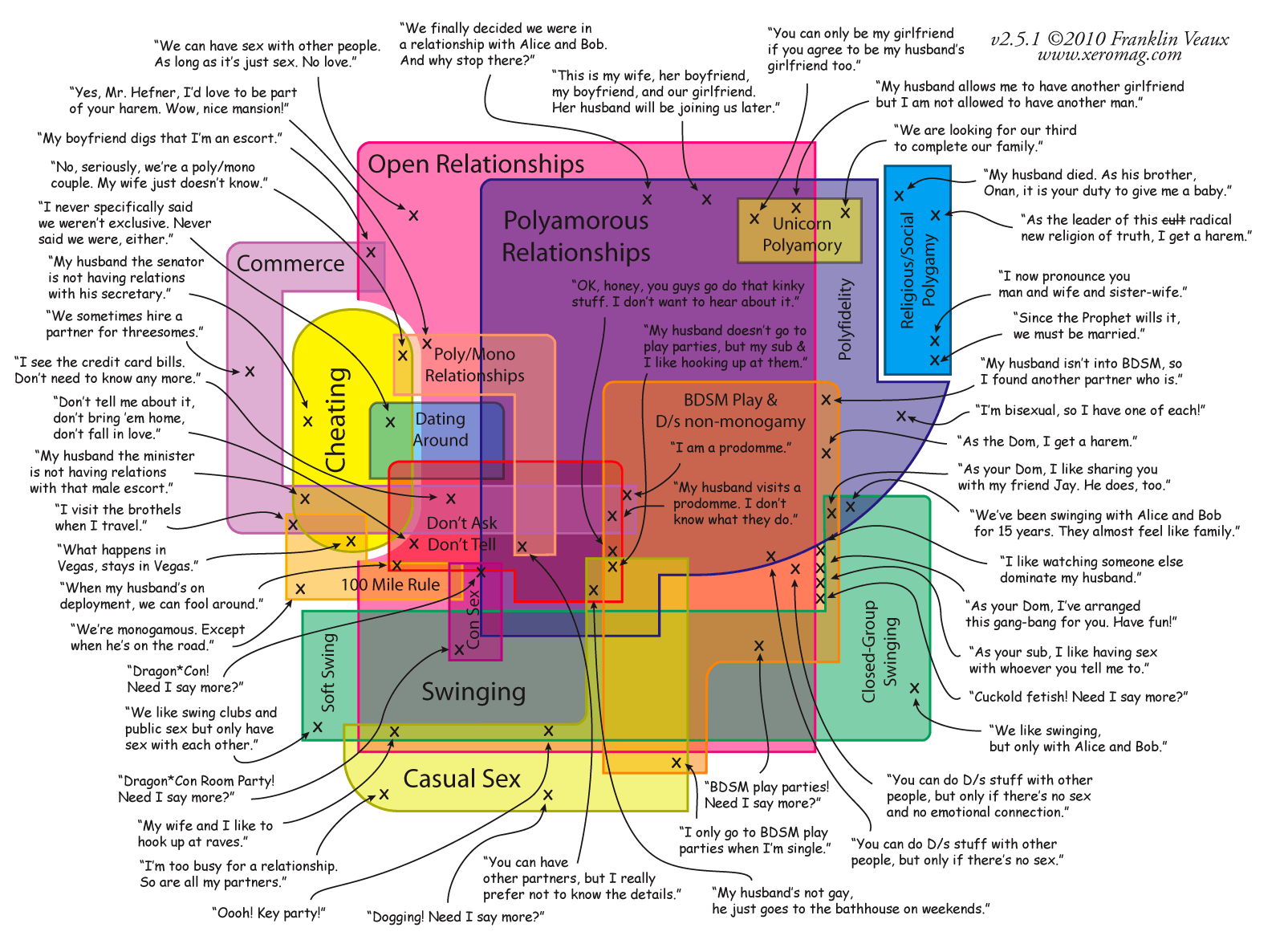
Swinging, open marriage, and polyamory are all forms of ethical, disclosed, or consensual nonmonogamy, meaning none of them are cheating, but they aren’t the same thing as each other.

Swingers have casual sex at clubs, events, or parties, usually ones that are mainly there or being held for the swinging element. Couples (and triads, and...) who swing have agreed with each other to do so.

Polyamory involves having a dating, romantic, partner, or spousal relationship with more than one person in a way to which those involved have agreed. For example, three people might live together as partners with each other in a triad. Or, one person might have ongoing dating relationships with three different people, none of whom spend time with each other, but all three of them are aware and agreeable to the fact that the person they are dating is seeing other people, not for the purposes of “picking” one of them, but on a continuing basis. Each of them may or may not be seeing or living with other partners. Polyamory can take many different forms.

An open marriage or open relationship is a marriage or relationship that isn't closed to new partners. The people in the marriage or relationship have agreed that one, both, or all of them are open to finding new partners, whether separately or together, whether those partners are for casual sex (like with swinging, or hookups, or threesomes) or a spousal relationship (like with polyamory), or some other way.

People in an open marriage or open relationship might swing, or might be polyamorous, or might look for casual encounters that aren't part of swinging. But many polyamorous people are in closed relationships and aren't open to having new partners. Some swingers consider their marriage or relationship only open for swinging and not anything else; it's not a generally open relationship and neither or none of them are looking for anyone outside of the context of swinging.

So...

Swingers may or may not consider themselves polyamorous.
Polyamorous partners may or may not swing.
Swingers might be in an generally open relationship or only be "open" for swinging.
Polyamorous relationships can be open or closed.

Whether you know it or not, you know people who are in consensually nonmonogamous relationships. You know people who are, or have been, swingers. You know polyamorous people. You know people in open relationships. People of all walks of life find these forms of ethical nonmonogamy suit them and their relationships. Some of them are health care providers, firefighters, accountants, airline pilots, military personnel, engineers. lawyers, educators, clergy, or stay-at-home parents.

Nonmonogamous people shouldn't be discriminated against or denied their rights. Let people have the relationships to which they've mutually agreed.
— — —

Monday, June 23, 2025

The Invisible Asterisk

Sometimes, when someone writes (or says) that they support the freedom to marry or, marriage equality, or #Marriage4All, #LoveMustWin,  or “love is love” or something like “The sex lives of consenting adults is nobody else’s business.,” there is an invisible asterisk. You know, one of these: *

What might really be going on is this…

“Consenting adults should be free to marry each other.”*


*Unless you mean something I don’t like or think is disgusting, like polygamy, open marriage, or consensual adult incest.


I don’t do that. There is no asterisk in this statement…

I support the rights of an adult to share love, sex, kink, residence, and marriage with any and all consenting adults, without prosecution, bullying, or discrimination.

There is no asterisk after “adult.” An “adult” includes any person, regardless of gender, sexual orientation, race, or religion.

“Any and all” means “any and all”. If an adult woman can vote, be Secretary of State (or Prime Minister, which we don't have in the US), serve as a Governor, be a CEO of a Fortune 500 company, sign contracts, enlist in the military, operate heavy machinery, be sentenced to life in prison or the death penalty (which we do have in many places in the US), and can consent to group sex with three cage fighters she just met, it seems to me an adult woman should also be free to have sex with and/or marry any consenting adult(s), even if that means another woman, or two women, or two men, or a woman and a man, or a married man (not hidden from his existing spouse), or her sister, whether an adopted sister, stepsister, half sister, or full blood sister. All of this goes for men, too, of course.

This basic right means all adults having the same right to not marry at all, and to divorce, and to be free of domestic violence. The basic freedom of association should mean that adults can share the entirety of love, sex, residence, and marriaqe, or any of those without the others, and any civil union or domestic partnership that is offered. That’s a funny thing called… equality. There is no good reason to deny equality. Now is the time to get it done.
So, do you support full marriage equality, or marriage “equality”*?
— — —

Sunday, August 18, 2024

"If You Have Sex With An Adopted Or Illegitimate Sibling..."

There was a question I answered a while back on Quora. The question was "If you have sex with an adopted or illegitimate sibling, is that incest?"

Since an "adopted sibling" could mean, among other things, 1) a biological sibling who was adopted by other parents; 2) a non-biological sibling adopted by your parents, I addressed both of those situations in my answer.

There are three definitions for consensual incest: 1) biological, 2) social/cultural, and 3) legal.

Someone who is adopted into your family is, in most places, legally and socially considered your family, and so while it wouldn't be incest biologically, it would be considered as such socially and legally where there are anti-consanguinamory laws and those laws include adopted relations, as laws vary from place to place. These laws are so ridiculous they would apply even if the sibling was adopted into your family as you were both middle-aged adults. In fact, you could marry someone and your parents could adopt that person and make your marriage incestuous. That's how stupid those laws are.

But the laws get even more ridiculous, where they exist. Let's say by "adopted sibling" you mean your sibling that your parents had before you, gave up for adoption, and never told you about. You meet that person completely unaware you had an older sibling, fall in love, marry, even have healthy kids together. (This has happened, by the way.) Then it is discovered they are your genetic/biological sibling. Even though they weren't legally or socially your sibling, they were biologically, and now those stupid laws criminalize your marriage and love. You're actually expected, by the law, to stop having sex with each other.

"Illegitimacy" is a concept that has largely been abolished as far as the law is concerned, at least is the US, where I live. It is also considered an offensive term by many. It means someone was born outside of a legally recognized marriage. In the past, it meant the child might not have a claim to their father's estate, for example. As far as anti-consanguinamory laws go, if your "illegitimate" sibling is your biological sibling, it would still be considered incest in all three ways.

An adult SHOULD be free to have sex with any and all consenting adults. Laws against that are unjust. What someone else wants to call it shouldn't matter.

If people are siblings by birth...

If people are siblings by adoption...

If they are stepsiblings because their parents married...

If they are genetic siblings but raised apart...

If they aren't related by law or genetics but grew up together...

...and they mutually consent to sex with each other, that shouldn't be something to be negatively labeled, shamed, discriminated against, or criminalized.

Siblings have been having sex for as long as there have been siblings, anywhere there have been siblings, regardless of class. There are siblings doing it right now, not far from wherever you are. Some have done it for recreation, some have done it to learn, some have done it for passion, some have done it for love, some have have it because they are living as spouses, some have done it for other reasons. It is their right and they shouldn't have to hide. There is no good reason to deny them their rights.
— — —

Wednesday, February 21, 2024

Is Polyamory Just Another Word For Swinging or an Open Relationship?

NO.

These three terms are not synonymous.

All three ARE forms of ethical nonmonogamy or consensual nonmonogamy or disclosed nonmonogamy.


Swinging can involve unattached individuals, but usually involves established couples (or even triads, quads, etc.) in group encounters with others, in which the focus is on casual sex. Sure, the people involved can be friends, even close and longtime friends, they might even love each other, but what's going on is that people get together at sex parties.

Open relationships, including open marriages, are relationships in which there is an existing, established bond, but those in the relationship have agreed that they are open to new partners, whether they are short term or long term partners.

There is also swapping, in which people in a relationship trade partners with people in another relationship, mostly for sex. This is usually done with just two or three couples, as opposed to at a party.

Polyamory means having a romantic, dating, courting, nesting, or spousal relationship with more than one person, with the agreement of all. It takes on many, many forms. It could be a triad who live as spouses to each other. It could involve a married couple who also have girlfriends/boyfriends they see individually or together. It could be four people who are dating each other on an ongoing basis. There are countless forms of polyamory. Some people are polyamorous as an orientation.

Some polyamorous relationships are open. Some are closed. Some polyamorous people engage in swapping and/or swinging, some don't.

Many people who are in open relationships or who swing or swap don't consider themselves polyamorous, especially if they're only looking for casual sex when they get with people outside of their relationships.

There are people in open relationships who are not swingers and do not engage in swapping. There are people who will do swapping but don't consider themselves swingers. There are swingers who do not identify their relationship as open, especially if the only time and place they will get sexual with others is at a swingers club/party.

So, the terms mean different things. And there are other forms of ethical nonmonogamy.


"Yeah, but aren't these all just different words for cheating?"

NO!

Cheating is breaking the rules.

Ethical or consensual nonmonogamy means that the people involved have agreements ("rules") that allow for what they are doing.

To be sure, there are people who are involved in these forms of ethical/consensual nonmonogamy who are sometimes involved in cheating, but that is because they broke the rules.

It is up to the people involved in a relationship what the terms of their relationship will be, and if and when those terms will change. As people go through life, their desires and needs can change and they might revisit the terms to modify them.

We need to ensure that adults, regardless of gender, can share love, sex, kink, residence, and marriage (and any of those things without the others) with any and all consenting adults, without fear of prosecution, bullying, or discrimination. There is no good reason our laws shouldn't protect these rights, and institutions and service providers need to except and account for the fact that some people are nonmonogamous, and not assume everyone is monogamous or wants monogamy, and certainly not try to force people to be monogamous.
— — —

Tuesday, February 28, 2023

Metamour Day - February 28

Tuesday, February 28, is Metamour Day.

It’s a day to celebrate the relationships people have with their metamours. Metamours are a partner’s other partners, or other significant others (OSOs). “Metamour” is a commonly used term in polyamory and sometimes in the wider ethical/consensual/disclosed nonmonogamy community.

Having a positive relationship with a metamour benefits everyone. Some metamours have little contact with each other. Others are best friends.

Do you have a metamour? Are you cordial? Friendly? Best of friends? If you're polyamorous and people in your life at metamours to each other through you, tell us about how that is going. Let us know by commenting below.


— — —

Friday, June 3, 2022

Not Too Close For Comfort

A comment came in on our popular entry "Aunts and Nephews"...
I'm currently in an active sexual relationship with my nephew. We aren't blood or marriage related. His mom and I are best friends and I helped raise him. The last time I saw him he was 11, we reunited now that he's 18 approaching 19. I'm 34. The attraction was instant and mutual. I feel like I am betraying my friend however, the amount of enjoyment and satisfaction I get from this guy is worth the risk. I think she suspects we're intimate but there's no proof. Her boyfriend is quite jealous that I don't look in his direction and tried to out nephew and I... Good luck, we both deny until we die! I don't want to stop, and neither does he. Any thoughts?
It's time to write a long-overdue essay on "fauxcest" or "nearcest" of whatever else this can be called. So that's below. But first, let's answer the questions raised Anonymous.

1) You two are consenting adults. You should be free to have this relationship. There's nothing wrong with having this relationship.

2) "I feel like I am betraying my friend..." This is not a rational reaction. It is a feeling that is based in prejudices and faulty reasoning. Your "nephew" would certainly be sexually active with someone, whether his mother is comfortable with that thought or not. Why is it is a bad thing that is with someone who already knows and cares about him? Sex isn't a bad thing, unless you are doing it wrong.

Someone might say to you "He's young enough to be your son" or to him "She's old enough to be your mother." But so what? Someone might go a step further and say he must be harboring a secret desire for his mother and you for your son (if you have one). That may or may not be true, but even if true, neither of you would find any scolding from us. It is very common for people to find someone who is like one of their parents or siblings, for example.

There's a chance your relationship will be outed (some of this advice might be helpful). And, it is likely that if that happens, your friend will be very upset with you. She might try to attribute her anger to the secrecy, but that would most likely just be an excuse. Neither of you is under any obligation to tell her the details of your sex life. If she finds out and is angry, give her time to cool off. You can tell her you understand her feelings without denying your entitlement to your love life. Many parents get upset at the thought of their child (even though their child is an adult) having sex. Some people get upset that someone they know is having sex  with someone to whom they're related. Neither reaction is based on logic, but rather things like aversion to change, feeling old, and even envy.

After she cools  off, she might realize that it can be a better thing that her son is with someone who has already known and cared for him. Some of this applies.


Enjoy what you have. There's no reason you shouldn't. Goodness knows there are many people out there who are miserable in a relationship or lonely. Why deprive anyone, especially yourself, of happiness?
— — —

Sunday, February 27, 2022

Metamour Day is February 28

Monday, February 28, is Metamour Day.

It’s a day to celebrate the relationships people have with their metamours. Metamours are a partner’s other partners, or other significant others (OSOs). “Metamour” is a commonly used term in polyamory and sometimes in the wider ethical/consensual/disclosed nonmonogamy community.

Having a positive relationship with a metamour benefits everyone. Some metamours have little contact with each other. Others are best friends.

Do you have a metamour? Are you cordial? Friendly? Best of friends? Let us know by commenting below.


— — —

Wednesday, May 5, 2021

Myth: Genetic Sexual Attraction is Just a Fancy Way of Saying Incest

Reality: First of all, Genetic Attraction or Genetic Sexual Attraction (GSA) describes an attraction, not an action, and incest is an action. So GSA is not an synonym for incest.

Not all GSA situations involve sex. However, even when it does involve sex, by definition the people involved in reunion GSA were not raised together or by one another, so were not socialized and bonded as family while growing up.

It might be classified as incest in law and biologically, but it isn’t incestuous socially.

Reunion GSA describes a specific experience that does not involve people who have been socialized as family; sex may or may not be involved.

Consider a hypothetical situation.

See Myth: GSA Doesn't Exist or is Very Rare
— — —

Thursday, March 25, 2021

Women Can Have Multiple Spouses, Too

Or, There’s More to Polygamy Than Polygyny

Women can enjoy multiple spouses, multiple husbands, multiple wives, multiple partners, multiple girlfriends, multiple boyfriends, and dating multiple people. A woman can love more than one person, have multiple ongoing romantic relationships, and have multiple ongoing sexual relationships.

Regular readers of this blog may find such statements to be obvious, but way too often, when I read or hear news or commentary about “polygamy,” what is meant is “polygyny” (one husband, multiple wives). Polyandry, meaning one wife with multiple husbands, has existed in tradition and still exists in modern relationships, and it is polygamy, too, as are spousal relationships between multiple women and multiple men, or three or more men, or three or more women.

This blog supports relationship rights for adults regardless of gender. A woman should be just as free as a man to marry more than one person, regardless of their genders or how closely related, and just as free as a man to not marry at all. or to leave a marriage.

Polyamory and Polygamy
— — —

Saturday, February 13, 2021

How Marriage Equality Supports Family Values and Morality

There are people who constantly make a point of telling us their beliefs that marriage is important for our countries, that being married is good for adults and for children, that commitment is good, that unmarried sex is bad, unmarried cohabitation is bad, that being a single mother is bad, and that marriage is needed to “channel male sexuality.” They cite with worry the fact that there are fewer married households now and more children being raised outside of a home headed by married parents. These are what they say “family values” and “morality” are about. Everyone should get married and only have sex and raise children in marriage and should go to church every week and enjoy “freedom of religion.”


Let’s consider some facts, at least how the stand in the US (your country may vary.)…
— — —

Wednesday, November 6, 2019

PSA: Polyandry is a Form of Polygamy

Far too many people refer to polyandry as the "opposite" of polygamy. Or people will say "Polygamy and polyandry..."

Polygamy is marriage or marriages between three or more people, regardless of gender.

Polyandry is marriage to multiple men.

Polygyny is marriage to multiple women.


So...


Polyandry is a form of polygamy.

Polygyny is a form of polygamy.

Polygamy has many forms. It can be three people, regardless of gender, married to each other. It can be four people, regardless of gender, married to each other. It can be one person, regardless of gender, with concurrent marriages to two, three, four, or more people, regardless of genders.

If everyone involved is a consenting adult, then polygamy in any form can be considered a form of polyamory, which itself is a form of ethical nonmonogamy.

This link and this link might help explain.
— — —

Monday, September 9, 2019

An Addition to the Glossary: Consanguinamorous

I am bumping up this classic entry.

*****

I have made some minor changes to the Glossary, and added a couple of terms. Since this blog began, I have favored the phrase “consanguineous sex” over the word incest to describe consensual sex between close relatives. This has meant writing “consanguineous couples” as opposed to “incestuous couples.”

I now think a better word is the word consanguinamorous. It’s a long word, but it may be useful in describing love or eroticism between close relatives. It implies the inclusion of sexuality, but that may not be so. Consanguineous sex can be expected between those who practice consanguinamory; couples, triads, or quads who are consanguinamorous. Some people would call this “intrafamilial sex” or “hyperendogamy.”

Please note that as always, this is referring to consensual sex, not to sexual assault, rape, statutory rape, child rape, or child molestation.
— — —

Wednesday, February 7, 2018

Consanguinamoroflexible

Another one of Jane's recent blog entries is about flexibility in sexuality, especially in how it relates to consanguinamory. Go read it here. What we've seen is some people are consanguinamorous, some consang-flexible, some "bisang" and so on.
— — —

Saturday, November 4, 2017

Friday, May 19, 2017

It Is Important to Distinguish Sex From Assault

Since this post will be talking about assault, I hereby provide a TRIGGER WARNING for those dealing with the trauma of sexual assault.

— — —