Translate

Showing posts with label polyamory. Show all posts

Friday, October 16, 2026

NOT a Good Reason to Deny (Polyamorous) Love #10


“Polyamory/polygamy spreads sexually transmitted infections.” Unprotected sex with someone who is infected is how such infections may be transmitted. Twenty people could have group sex and a group marriage for fifty years and if none of them brings an infection into the marriage and they only have sex with each other, none of them will get a sexually transmitted infection.

We do not deny people their freedom to marry based on which diseases they have. In most places, people can legally have sex with multiple partners anyway. Polyfidelity can be encouraged if polygamy is legalized and polyamory is no longer stigmatized, which would actually reduce disease transmission. Polyamorous people tend to be more careful about prevention, safer sex, and actually talking about the issues involved.

There is no good reason to deny an adult, regardless of gender, sexual orientation, race or religion, the right to share love, sex, residence, and marriage (or any of those without the others) with any and all consenting adults without prosecution, bullying, or discrimination.

Feel free to share, copy and paste, and otherwise distribute. This has been adapted from this page at Full Marriage Equality: http://marriage-equality.blogspot.com/p/discredited-invalid-arguments.html

Go to NOT a Good Reason to Deny Love #9 

Go to NOT a Good Reason to Deny (Polyamorous) Love #11

— — —

Sunday, October 11, 2026

Coming Out Day 2026

Life can be tough for someone whose identity and orientation doesn’t fit in to a narrow little heterosexual, monogamous, "traditional"-gender-role box or whose relationship doesn’t meet the local sex police’s approved standards. Sometimes, a person or the people in a relationship want to come out of the closet. Sometimes they need to come out. For some of these people, it is a little less difficult if they do so as part of a communal event, such as National Coming Out Day.

National Coming Out Day is TODAY, October 11. Here’s the official website, at least for the US. There is much helpful information there, regardless of where you live.

The more people that come out, the more the others around them will realize they do know and appreciate people who are LGBTQ+, or polyamorous or otherwise nonmonogamous, or consanguinamorous, and that such people and relationships deserve equality. So coming out helps progress.

On the other hand, it is understandable that any given person, couple, triad, or quad decides to stay in the closet for now. There’s still so much hate, so much prejudice and persecution, and even unjust laws that hinder the life and love of people who are good citizens and just want to be themselves. I support the decision of anyone who believes they need to be reserved for now for the sake of their safety and family.

The decision to come out is yours. Do you want to come out, and to whom? Your friends? Your family? Your coworkers? Your classmates? Your neighbors? Your crush? The whole world?

Also, if someone comes out to you, the decision to be an ally is yours. If your classmate, coworker, neighbor, friend, parent, child, or sibling comes to you and says they are gay, lesbian, bisexual, polysexual, pansexual, transgender, non-binary, genderfluid, polyamorous, nonmonogamous, consanguinamorous or in a consanguinamorous relationship, what will you do? Will you choose love and acceptance?

Even if you are heterosexual, monogamous, and nonconsanguinamorous, you may want to come out as an ally for full marriage equality. That alone can take courage, but it helps.

If you are planning to come out, or you do come out, please feel free to share your experience here by commenting. You can do so anonymously. You are also welcome to contact Keith if you want someone to talk with. The best ways to do that are to email fullmarriageequality at protonmail dot com or message fullmarriageequality on the Wire messaging app.
— — —

Friday, October 9, 2026

What Is Cheating?

Cheating is breaking the rules.

In a relationship, the rules are set by the people in the relationship.

As such, for some, having sex with other people is NOT cheating. If the rules of their relationship allow for having sex with other people under certain conditions, and those conditions are met, then it isn't cheating.

Also, relationships can and do have rules other than "don't have sex with other people" or "only have sex with other people under these conditions." Those rules can be almost anything to which the people in the relationship have agreed, including "Don't spend more than this amount of money on something without discussing it with me first." That's a very common rule for people who have combined their finances.

Another rule that can apply to sex is "We will share sexual affection on a regular basis, as long as extraordinary circumstances don't prevent us." Thus, cheating can include one partner consistently rejecting the other partner, cheating that partner out of something to which was agreed.

While there are common basics that should be discussed with every (potential) partner, it's difficult to discuss every possible hypothetical nuance and variation and agree to rules about each, and so being flexible about adding, removing, or modifying rules can be helpful, especially since people discover more about themselves, what they have to offer, and what the need as they age and grow. Keep in mind that most people have a tendency to have expectations and desires, and make assumptions, that go unstated, and someone can still damage trust and their relationships with the partner(s) without technically cheating. So, please, state upfront some of the basics and work from there. These might be "I am mostly monogamous and need my partner to be mostly monogamous" or "I'm ethically nonmonogamous" or "I am polyamorous" and go from there, detailing what is meant. 

Strict monogamy shouldn't be expected by default; it must be something that is discussed, with an agreement being made. None of us can assume that someone we are interested in is "available" because they're not in a relationship, or that they are "unavailable" because they are in a relationship. That is something to discuss with them.
— — —

Monday, October 5, 2026

Respect For Marriage Act

Like many countries, the US needs a national "Respect For Marriage Act."

Our laws should ensure that an adult is free to marry any and all consenting adults, and have their marriages respected under the law, in courts, by schools, in hospitals, by insurance agencies, and so forth. This should be the case in every state, county, and city.

Ideally, we would adopt a Marriage Equality Amendment that supports diversity, equity, and inclusion.

There is no good reason to deny an adult, who is capable of consent, regardless of their age, race, ethnicity, national origin, religion, gender, sexual orientation, or any other personal characteristic, their rights to consent to relationships, love, sex, kink, residence, or marriage with any and all consenting adults.

Denying the polyamorous right to marry shouldn’t be part of any law. Equality “just for some” isn’t equality.

Let's support full marriage equality.
— — —

Saturday, September 26, 2026

Twins and Double Cousins

Throughout history, it has been more common than present-day people in densely populated areas would think for, say, a man to marry a woman and then for that man's brother to marry that woman's sister. If the larger families get along, it can make a lot of sense. It gets more attention these days when the siblings are two sets of identical twins.

Becky Pemberton reported at the-sun.com on such a situation, which is more newsworthy because both couples had children within months of each other. [This post has been bumped up so external links may no longer work.]

Brittany and Briana are identical twins who married identical twins Josh and Jeremy Salyers and then gave birth to babies within months of one another. 
 
They uploaded an Instagram post of their adorable sons Jett and Jax and said they are “Cousins, genetic brothers, and quaternary twins.”

When children are born to both of those married couples, those children are first cousins twice over to each other, or "double cousins." They are first cousins through their mothers, AND first cousins through their fathers. This is true whether or not the sisters are twins and whether or not the brothers are twins. Genetically, the double first cousins are like siblings to each other. Once they are grown, legally, those first cousins can marry in about half of US states and have sex in all but a handful of US states, whereas siblings can't legally marry in any of state and can legally have sex in only three. It's another example of how ridiculous the laws are, and another example of how genetic concerns are not the reason for unconstitutional bans on the consanguineous freedoms to sexuality and marriage.

Brittany and Briana met Josh and Jeremy at a festival for twins in 2017 and the Salyers blokes proposed six months later, following a whirlwind romance. 
 
They had a joint wedding on August 5, 2018, live in the same home in Virginia, US, and are now expanding their families together.

Twins, especially identical twins, can be very close, and as the article stated, these twins have done so much of life together, and they are living together. While the article does not say one way or the other, it isn't out of the range of possibility that this situation involves polyamory and consanguinamory. Either way, we wish them well.

Have you known of similar situations? Maybe you know of someone who ended up having marriages to more than one person from the same family? As always, feel free to comment below.


— — —

Saturday, September 19, 2026

Ethical Nonmonogamy is Not Cheating

Cheating is breaking an existing agreement or vow and keeping/intending to keep that breech of the agreement a secret from the person or people with whom it was made rather than informing the other(s) that the agreement is over (which is "leaving").

Ethical nonmonogamy is not cheating. (ENM may also be known as “consensual nonmonogamy” or “disclosed nonmonogamy.”)

For example, Mark and Jenny are swingers. Their agreement is that they will only be with others when they are both present. Anything more than a hug or kiss on the cheek with someone else, or revealing genitals to someone else in a social context, when they are not together, is a no. They attend parties together and have sex with others there; that's not cheating. But while Jenny is out of town on business, Mark picks up a woman at a bar and she gives him oral sex. Under the agreement he has with Jenny, this is cheating. Other swingers have different rules.

Some people have open relationships/marriages and a "don't ask, don't tell" policy, meaning the partners can be with others and won't ask or tell each other about who or what or when, often with certain conditions such as using protection and having STI tests. If you're not communicating with a potential partner's other partner(s), you can't be sure that being with you wouldn't involve your potential new partner cheating. Ultimately, though, at some point you just have to trust what someone tells you because establishing an absolute negative is extremely difficult. How can you be sure they don't have an agreement with some other person out there that would be breached with whatever you're doing? You can't. You can only be sure that you're not cheating on someone.*

Ethical nonmonogamy can take many forms, from lifelong spousal triads and quads (polyamory) to couples swapping to swinging to open marriages to couples engaging in the occasional casual threesome to someone living alone but having casual hookups. Informed consent is the core of all of this. While ENM is not cheating, people who profess or attempt to maintain ENM might cheat, just like monogamists might cheat. If there is a closed triad and someone in the triad has a secret lover on the side contrary to the agreement with the two others in the triad, that's cheating. "Fluid bonding" is a term used in polyamorous circles. Someone might only have unprotected sex with one person, and protected sex with others. Going without protection would be a form of cheating.

One should never assume that someone who is married or at least coupled isn't available, although one can certainly decide they don't want to be with someone who is married or coupled. That's each person's decision to make. Just because someone is married or has a partner doesn't automatically mean they aren't available for romance or sexual affection or some other social activities (meals together, going to the theatre).

While one may decide that kissing someone else is cheating and a deal breaker for their relationship, not all cheating has the same implications and risks.


— — —

Sunday, July 5, 2026

You’re Not Alone - Reach Out

You are welcome to reach out to me. Although there are now, thankfully, many places for LGBTQ+ people and nonmonogamous people to find others and supportive people to talk with, it can still be difficult for people with consanguinamorous feelings or experiences to find someone to talk with.

Anyone can reach out to me, Keith, and I never share what someone tells me privately with anyone else unless you give me permission. Thousands of people have contacted me over the years. You can see for yourself how long this blog has been here.

One of the best ways to reach me is via email: fullmarriageequality at protonmail dot com. [Please note that if I will usually respond within a day or less, so if you you don’t see my response, check your spam or junk folder. If you still don’t see a response, try contacting me another way.]

Another great way is Wire messaging app: fullmarriageequality

I’m also in these places, where I can be sent private/direct messages: 


I know there are many people who visit this blog who never reach out, and I understand. Thanks for visiting. Everyone is also welcome to comment, including anonymously, on posts here. You’re also welcome to write to me privately, even if just to say “hi.”
— — —

Tuesday, May 19, 2026

Starting or Joining an Affirming Club at Your School

Not only are school years a time for intense personal discovery and growth, but they are usually a time of intense pressures, including the pressure to conform, and bullying. Some students have a life outside of school that can be downright hellish, and even a not-so-great school environment can be better than where they live.

For those reasons, affirming clubs are critical. Over the years there have been various names for them, such as Gay-Straight Alliances, or Gender and Sexuality Associations, or Diversity clubs, among others. Any club or program that supports gender, sexuality, and relationship diversities in students and their families can be of help. Equity, inclusion, and belonging make a positive difference.

If your school doesn't have such an organization, consider starting one. See here. As a new school year gets underway, don't let your school be without such an organization!

If you school already has one, consider joining and/or supporting it. Student, faculty, and parental support are all needed.

If the administration of your school will not formally sanction such a club, create a club anyway.

Whether starting or joining, please do what you can to make the organization welcoming, inclusive, accepting, and affirming of all whose identity, sexual orientation, relationship orientation, or existing relationship (or that of their parents) makes them a target for discrimination or bullying.
— — —

Sunday, May 3, 2026

An Unabashed Free Spirit

We have another exclusive interview to bring you. 

People in consanguinamorous relationships are everywhere, though consanguinamorists tend to be closeted. Fortunately, some are willing to be interviewed for this blog. As a result, Full Marriage Equality has featured scores of exclusive interviews with lovers denied the freedom to marry and have that marriage treated equally under the law. Most can’t even be out of the closet or they’ll face persecution and prosecution under absurd incest laws, which, instead of focusing on abuse, also target consensual relationships.

The woman interviewed below should be free to legally and publicly marry her lovers, or simply be together without having to hide, yet they can’t. Prejudice can be deadly. They are consenting adults; why should they have been denied their rights? In much of the world, they could be criminally prosecuted for loving each other this way, and might be persecuted severely in addition.

Read the interview below and see for yourself what she has to say about the love they share. You may think this relationship is interesting, or it might make you uncomfortable, or you might find it ideal, even highly erotic, but whatever your reaction, should lovers like these be denied equal access to marriage or any other rights simply because they love each other this way?

Also please note that someone you love, respect, and admire could be in a similar relationship right now. Should they be attacked and denied rights because of the "incest" label? 

NOTE: This interview has some sexually explicit descriptions inherent to the interviewee’s life experience and the development of her philosophy.


*****

FULL MARRIAGE EQUALITY: Describe yourself.

Robin: My name is Robin. I’m 33, a single mother of two; my son and my daughter. We live in the southwest United States. I have one sibling, my brother, Mark, who is two years older than me. We run a successful family business that allows us to live comfortably. I enjoy time with my friends and, of course. my family.  


FME: Are you married or have you ever been legally and/or ceremonially married?

I am not married nor have I ever been. I don’t personally believe in marriage, but have no conflicts with those who do. My brother has never been married, either. 


FME: How would you describe your gender? How would you describe your sexual orientation and your relationship orientation... are you heterosexual, bisexual, what? Are you monogamous, polyamorous, or....?

I am female and I identify as female. I am bisexual, definitely nonmonogamous. 


— — —

Friday, March 13, 2026

NOT a Good Reason to Deny (Polyamorous) Love #16


“Some men will be left out as polygyny increases.” This is based on the assumption that in a culture with gender equality, polygyny would still be more plentiful than polyandry. Anti-equality people, based on this assumption, insist that this will result in unmarried men devolving into criminals.

The mistake here is assuming that the second, third, etc. wives in a polygynous marriage would have wanted one of those unmarried men rather than legally sharing the man they did marry, and that the unmarried men would in turn want to marry them. Some of those men may want to marry men, or not marry at all. Why not allow people to marry the person or people of their choice? Why try to force people to settle? Also, the system is not closed. There are billions of people in the world and more and more people are reaching the age and status of eligibility every second.

There was a study attempting to link polygny to criminal behavior in unmarried/unpartnered men based in part on nineteenth century frontier America. Things have changed a little since then. And guess what? Married men commit crime, too. Most of the men in prison have been married, were married or had at least one girlfriend at the time they were convicted.

Maybe men in the hypothetical polygynous community who don’t get married are violent people. Is it better that they have a wife to beat instead of committing crimes on the street? I don’t want to be the one who tells a woman she can’t marry the man/men or woman/women she wants; rather, she has to marry a less desirable man so that he can take his aggression out on her.

The warnings that polyamorous or polygamous freedom to marry will result in an increase of violent gangs of unmarried men committing crimes falls flat when one considers the overwhelming data revealing both that 1) Men in the US are getting married for the first time later than ever, and 2) Crime rates in the US have decreased.

There is no good reason to deny an adult, regardless of gender, sexual orientation, race or religion, the right to share love, sex, residence, and marriage (and any of those without the others) with any and all consenting adults without prosecution, bullying, or discrimination.

Feel free to share, copy and paste, and otherwise distribute. This has been adapted from this page at Full Marriage Equality: http://marriage-equality.blogspot.com/p/discredited-invalid-arguments.html

Go to NOT a Good Reason to Deny (Polyamorous) Love #15 

Go to NOT a Good Reason to Deny (Consanguineous) Love #17

— — —

Monday, February 23, 2026

Metamour Day - February 28

February 28 is Metamour Day.

It’s a day to celebrate the relationships people have with their metamours. Metamours are a partner’s other partners, or other significant others (OSOs). “Metamour” is a commonly used term in polyamory and sometimes in the wider ethical/consensual/disclosed nonmonogamy community.

Having a positive relationship with a metamour benefits everyone. Some metamours have little contact with each other. Others are best friends.

Do you have a metamour? Are you cordial? Friendly? Best of friends? If you're polyamorous and people in your life are metamours to each other through you, tell us about how that is going. Let us know by commenting below.


— — —

Sunday, January 25, 2026

Is Polyamory Just a Renamed Swinger Lifestyle or Open Marriage?

No. This is a common misconception.

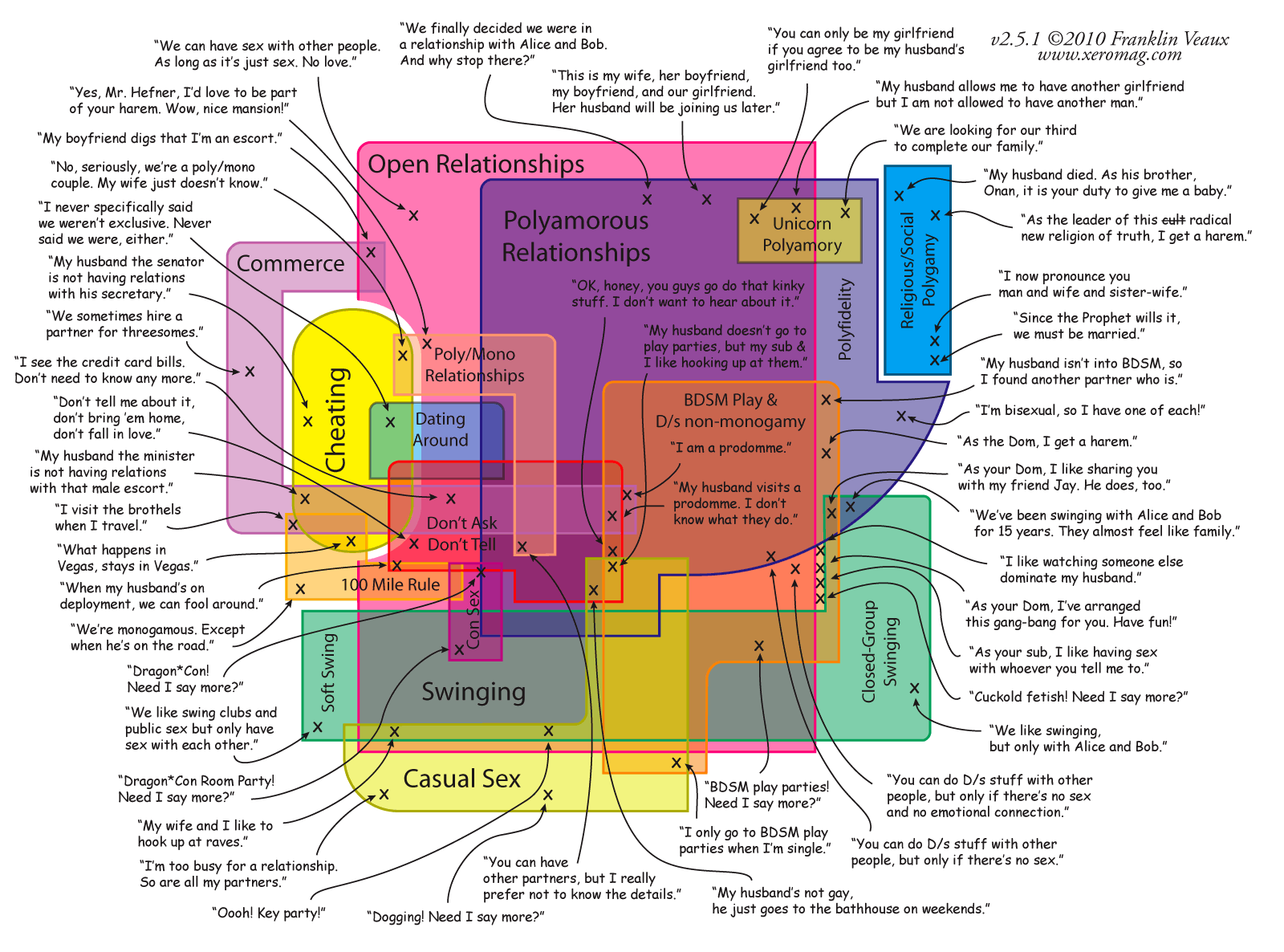
Swinging, open marriage, and polyamory are all forms of ethical, disclosed, or consensual nonmonogamy, meaning none of them are cheating, but they aren’t the same thing as each other.

Swingers have casual sex at clubs, events, or parties, usually ones that are mainly there or being held for the swinging element. Couples (and triads, and...) who swing have agreed with each other to do so.

Polyamory involves having a dating, romantic, partner, or spousal relationship with more than one person in a way to which those involved have agreed. For example, three people might live together as partners with each other in a triad. Or, one person might have ongoing dating relationships with three different people, none of whom spend time with each other, but all three of them are aware and agreeable to the fact that the person they are dating is seeing other people, not for the purposes of “picking” one of them, but on a continuing basis. Each of them may or may not be seeing or living with other partners. Polyamory can take many different forms.

An open marriage or open relationship is a marriage or relationship that isn't closed to new partners. The people in the marriage or relationship have agreed that one, both, or all of them are open to finding new partners, whether separately or together, whether those partners are for casual sex (like with swinging, or hookups, or threesomes) or a spousal relationship (like with polyamory), or some other way.

People in an open marriage or open relationship might swing, or might be polyamorous, or might look for casual encounters that aren't part of swinging. But many polyamorous people are in closed relationships and aren't open to having new partners. Some swingers consider their marriage or relationship only open for swinging and not anything else; it's not a generally open relationship and neither or none of them are looking for anyone outside of the context of swinging.

So...

Swingers may or may not consider themselves polyamorous.
Polyamorous partners may or may not swing.
Swingers might be in an generally open relationship or only be "open" for swinging.
Polyamorous relationships can be open or closed.

Whether you know it or not, you know people who are in consensually nonmonogamous relationships. You know people who are, or have been, swingers. You know polyamorous people. You know people in open relationships. People of all walks of life find these forms of ethical nonmonogamy suit them and their relationships. Some of them are health care providers, firefighters, accountants, airline pilots, military personnel, engineers. lawyers, educators, clergy, or stay-at-home parents.

Nonmonogamous people shouldn't be discriminated against or denied their rights. Let people have the relationships to which they've mutually agreed.
— — —

Sunday, December 14, 2025

A Cautionary Tale of Polyamorous Consanguinamory


This wont be an easy or quick read. [Note: This was originally published several years ago. I’m bumping it up because it’s tied to this season. I’d very much like to publish an update on this family.]

This is an in-depth recounting from a woman who was in a polyamorous consanguinamorous triad of her own initiation. It has been several years since it ended.

It’s a cautionary tale, though, unlike most of the interviews you'll find here, because they didn’t ever *talk* about it. They never discussed anything about it. They just did it. That, along with feeling isolated because of societal negativity, made things stressful for this woman.

Communication is important in any relationship. It is especially important in polyamorous relationships, and especially polyamorous relationships that were already established before they became sexual. It’s vital when three or more people are involved. If you can’t communicate about what's going on, you shouldn’t really be attempting an ongoing relationship. Consanguineous sex is almost always explosive. The intensity is unlike anything else. There’s a reason we call it double love or a double bond. Some people liken it to an addictive drug, and this woman does, too.

Communication is important. Reaching out to others is important. Reading the whole account will take a while. As you read this, notice how things could have turned out differently if they had talked things through, and didn’t have to hide.

I present her experience in her own words below. I have organized what she told me, but these are her words. If you contact me about her, refer to her as Zoe.

PLEASE NOTE THAT SOME OF THE NARRATIVE BELOW RECOUNTS EXPLICITLY SEXUAL SITUATIONS.


*****

I’m a mid-to-late twenties female and I was in an extended sexual relationship with both parents. For a long time I've felt really isolated, and if there's someone out there that can read what happened to me and say, "Yeah, I feel that too," that's a good thing. It started when I was 18 and ended when I was 22.

— — —

Saturday, November 8, 2025

Answering Arguments Against Polyamory


People who insist monogamy is the only acceptable relationship model, or that polyamorists should not have the same rights for their relationships as monogamists, almost always cite a few often-repeated reasons as to why. If you're polyamorous, you’ve probably heard most of these reasons, whether from coworkers, family, or complete strangers. Although I’m going to focus on polyamorous relationships, most of these are also applicable to open relationships, swinging, swapping, nonmonogamous sex, and ethical nonmonogamy in general whether the people involved identify as polyamorous or not.

Just about any objection people have to polyamory or other forms of ethical nonmonogamy fit into these common arguments, perhaps with different wording. Just so that you know, when I use the term “polygamy” I am referring to a subset of polyamory that involves marriage (whether by law, ceremony, or declaration of those involved), involving three or more spouses, whatever the structure of the relationship or the genders involved, as long as all involved are consenting adults.

1. “It is disgusting.” Also known as the “ick” or “eww” factor, this explains why the person using the argument would not want to have a polyamorous relationship, but their own personal disgust is not a justification for preventing other people from having a polyamorous relationship. Some people are disgusted by the idea of heterosexual sex, or their own parents having sex, but obviously this is not a justification to ban those things. Obviously, the consenting adults who want a polyamorous relationship aren’t disgusted by it. An effective response to this is “Don’t want a polyamorous relationship? Don’t have one.”

— — —

Sunday, September 21, 2025

Polyamory is Not Synonymous With Promiscuity

Polyamorists are diverse. About the only thing all polyamorous people have in common is that they are 1) people and 2) polyamorous. There are polyamorous people everywhere, and there always have been. Some tend to conform to the larger culture around them and seem as "average" as can be, some are countercultural. Polyamorists vary in sexual orientations, philosophies, faith traditions, political affiliations, lifestyles, and just about every way humans can be diverse.

They are also diverse in how they live out polyamory, which is why "polyamory" is definitely not synonymous with "promiscuity" if promiscuity is defined as "the practice of having casual sex frequently with different partners or being indiscriminate in the choice of sexual partners."

Some polyamorists never engage in casual sex and are very particular about their choice of sexual partners, and some will have fewer sexual partners over the course of their life than many people who identify as monogamous. Yes, there are some polyamorists who are promiscuous, but promiscuous polyamorists aren't the only people who are promiscuous.

None of this is to intended to be negative towards casual sex or promiscuity. just to clarify that polyamory and promiscuity are not the same thing. Someone can have two lifelong partners they didn't have sex with until well into their relationship and be polyamorous. And just because someone enjoys some casual sex with a few different people doesn't mean, necessarily, that they are polyamorous.

One of the beautiful things about letting consenting adults negotiate their own encounters and relationships without laws or other forms of discrimination interfering is that you can have things the way you feel is best and your neighbor can have completely different relationships, and you and your lovers can all have what you need. This is yet another reason to support full marriage equality and relationship rights for all.
— — —

Thursday, August 14, 2025

Consulting An Attorney If You Can't Legally Marry

If we had relationship rights for all, including full marriage equality, so many of the troubles facing so many people would go away.

But we don't have that yet.

So people in certain relationships face discrimination ranging from employment and housing discrimination, to denial of the freedom to marry, to imprisonment.

In the US, the people who help you with matters of law are called lawyers or attorneys. Other terms might be used in other countries.

In the US, you still can't be legally married to more than one person at the same time, and you can't be married to someone who is "too closely" related to you. (How close is "too close" varies by state.)

If you are in such a relationship, you can still have certain things similar to being legally married, such as:
  • shared financial accounts and investments
  • shared purchases, ownerships, and sales
  • sharing a residence
  • beneficiary or reciprocal beneficiary status
  • hospital visitation
  • being able to make decisions for one another should one of you become unable to communicate or dementia, memory loss, or mental illness necessitates someone else make decisions on your behalf
Without being legally married and without having paperwork that says otherwise, partners are not treated as next of kin or survivors; a biological or legal relative, even if estranged, indifferent or hostile will usually be considered next of kin, be able to make medical decisions, exclude partners from hospital visits, and claim ownership of the person's estate when they pass.

It might be worth it for you and your partner(s) to consult a family law and/or estate planning attorney. A good attorney can come up with the paperwork that will allow you to be responsible for each other, before and above anyone else.

DO NOT tell the attorney, no matter how kind and trustworthy, you’re lovers. They don’t need to know that and it can only cause problems. Rather, explain what it is you want, which might involve joint ownership or control of something financial, “power of attorney,” "medical power of attorney," reciprocal beneficiaries, and whatever else. Explain you want to be able to make decisions for each other and visit each other, before/above anyone else. You want to be considered primary next of kin to each other, you want custody of your minor children to go to each other in the event one of you passes - if that's what you want.

Over the years, some partners have used adoption, with one partner legally adopting their adult partner(s).

What options work best for you and your partner(s) can be determined if you hire a good lawyer. Lawyers aren't cheap, but depending on what you want, their help can be worth it.

Keep in mind that in situations in which genetic relatives were raised apart, they are often not considered family for things like inheritance, but are still treated like family when it comes to prosecuting them for being together. That is just one example of why they might need the help of an attorney and yet shouldn't tell the attorney if they are lovers.
— — —

Monday, July 21, 2025

Frequently Asked Question: Why Do Polyamorists Get Married?


The question is asked as though the person asking assumes that actual monogamy is a requirement for marriage. It isn’t in most places, even though current marriage laws will only allow monogamy in the legal sense.

For the purpose of this question and answer, I will include any form of honest nonmonogamy, or any label applied, such as open relationship, open marriage, swinging, swapping, polyamory, polyfidelity and polygamy.

Why do swingers get married?

Why do people in open relationships get married?

Why do polyamorous people get married?

The short answer is: For the same reason most other people get married. They want to get married, they think it is the best thing to do at that time in life, or they’re pressured.

— — —

Saturday, June 28, 2025

Why Am I Polyamorous?

There are diverse reasons as to why someone is polyamorous. This is apparent from the basic fact that there are many ways to be polyamorous, and that some people recognize they are polyamorous as part of who they are; it's not based on what they do, whereas others consider it something they do, not necessarily part of their identity.

When someone asks me why I am polyamorous, I could talk about it for hours. But I'm going to keep it short here.

I have a polyamorous orientation. (No, not all men are polyamorous.)

I realized I can care for more than one lover at a time. Whether it’s flirting, going out on dates, long intimate conversations, physical affection, celebrating special occasions, being there when someone is suffering and needing company or help, or otherwise spending time together, limiting all of that to one person feels extremely confining to me.

In addition, I don’t need someone I'm seeing or with to only get those things from me. In fact, I am fortunate enough to experience compersion, so I tend to like it when someone I'm seeing or with also has good experiences and bonds with someone else.

That’s the most basic way I can explain it.

I support your right to have the relationships to which you and your lovers mutually agree, and I hope you support mine.
— — —

Saturday, June 7, 2025

NOT a Good Reason to Deny (Polyamorous) Love #13


“This will cause inheritance disputes.” This can’t be a reason for the continued denial of the polyamorous or polygamous freedom to marry. Again, if we're talking about children, not all polyamorous marriages will have children. But even with today’s restriction of monogamy-only for marriage, we see inheritance disputes all of the time. Widows and widowers who were married only once get in fights with their own children, who may fight with each other. Then, in some cases, there are children born outside of that marriage. There’s divorce and remarriage with or without stepchildren or making more children, there are people who were never married who have kids, there are childless people whose inheritances are disputed, "monogamous" and polyamorous people who had children with multiple people without having been married to any those partners, on and on it goes. If anything, legalizing polygamy would make it easier to sort out inheritance. There can be default rules in the law, and people can come up with their own documented, legal agreements.

There is no good reason to deny an adult, regardless of gender, sexual orientation, race or religion, the right to share love, sex, kink, residence, and marriage (and any of those without the others) with any and all consenting adults without prosecution, bullying, or discrimination.

Feel free to share, copy and paste, and otherwise distribute. This has been adapted from this page at Full Marriage Equality: http://marriage-equality.blogspot.com/p/discredited-invalid-arguments.html

Go to NOT a Good Reason to Deny (Polyamorous) Love #12 

Go to NOT a Good Reason to Deny (Polyamorous) Love #14

— — —

Tuesday, April 1, 2025

We Get Letters

This blog gets comments on many posts.

I wanted to print this comment here because I couldn’t publish it in its original form as I needed to redact a word.

I’m trying to keep things here as “safe for work” as possible, and certain combinations of letters prompt filters to kick in.
 
Left after this entry…


…was this comment:

My mother had a sexual relationship with her own biological father. She always said he was her favorite lover. Growing up she was in an open relationship with my father. She never hid her sexual relationship with her father.

Mom often talked about her father using her and he encouraged her to be free sexually.

When I was home from the navy she and I had a few drinks, I admitted that I wanted to make love to her. We did. It was awesome, loving, kinky.

She had a friend who was sexually active with her own son so we often hung out and often played together. Her friend’s son was thin but mom loved his big c—-.

Thank you for sharing that, Anonymous. Congratulations on your experiences.

Anyone can submit comments after entries on this blog. You can also email Keith at fullmarriageequality at protonmail dot com.

— — —