Translate

Friday, September 20, 2019

Don't Panic If Your Partner Brings Up Swinging

...or any other form of ethical nonmonogamy.
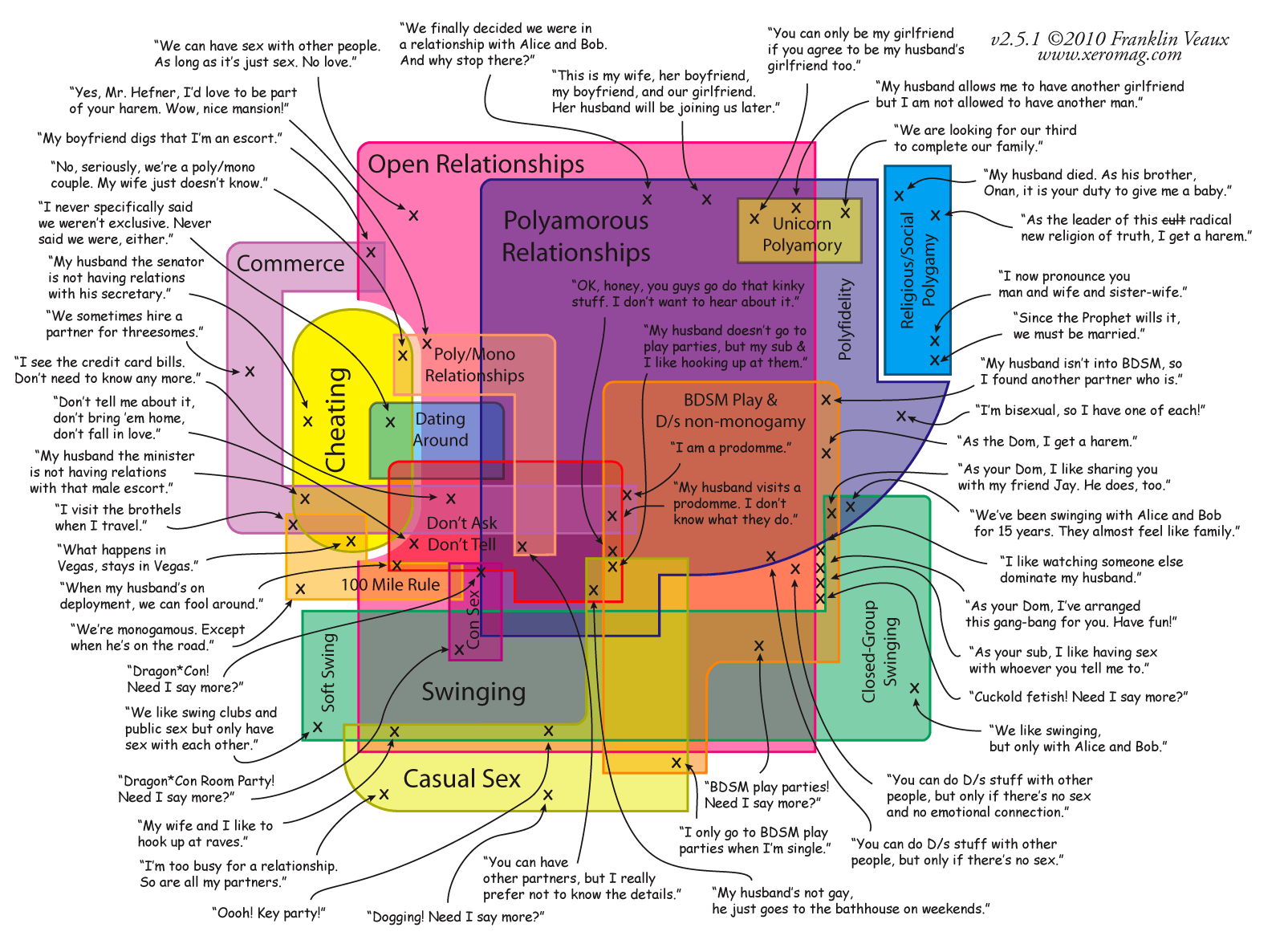
Ever notice that many of the same people who say swinging, or any form of ethical nonmonogamy will destroy a marriage urge someone whose spouse has merely raised the possibility of ethical nonmonogamy to divorce that spouse? Recently I heard two professional commentators who often focus on relationships urge divorce and say something akin to "your marriage is already over" because the spouse brought it up, even though these commentators disagree about many things when it comes to relationships. Then there are the online comments from the masses, which often say the same thing. I was glad to see this answer on Quora from Franklin Veaux, who is an excellent communicator of valuable information regarding ethical nonmonogamy and sex and relationships in general. Let's think things through here.
— — —

Tuesday, September 17, 2019

It’s Not True That New Jersey Siblings Won Marriage Rights in Court

There are a "news report" recently that appears to be satirical, that said a brother and sister in the US state of New Jersey had won a Supreme Court decision allowing them to marry. Here's an example.

Unfortunately, it isn't true. 


It's outrageous that any consenting adults would be denied such a basic freedom as their right to marry. There are countless siblings who wish the news was real, but are cruelly forced into the closet.

It doesn't matter if other people think it is strange, or disgusting, or it is against their religion. They don't have to do it. Consenting adults, under equal protection of the law, should be free to have the relationships to which they mutually agree. 

Full marriage equality is needed sooner rather than later.

Help make the fake news real.
— — —

Monday, September 16, 2019

It's Bisexual Awareness Week

September 16 through September 23 is Bisexual Awareness Week, with the 23rd being Bisexuality Day.

Co-founded by GLAAD, Bisexual+ Awareness Week seeks to accelerate acceptance of the bi+ (pansexual, fluid, no label, queer, etc.) community. #BiWeek draws attention to the experiences, while also celebrating the resiliency of, the bisexual+ community.

Bisexuals, like anyone else, should be free to be themselves have the relationships with other consenting adults to which they mutually agree, without fear of prosecution, bullying, or discrimination. Bisexuality is not a bad thing. Bisexual people deserve the same rights as anyone else.

We are happy to have bisexual friends and readers. As always, you are welcome to add to what is here by commenting below.
— — —

Saturday, September 14, 2019

Your Son's Choice in Media Content

Someone recently found this blog searching "My son has started to view incest porn." [This entry has been bumped up because it is still relevant.]

What does it mean that your son is viewing "incest porn"?

There is a wide variety of material that can fall under that category.

1. Are we talking about professionally produced videos, featuring unrelated actors, like the classic "Taboo" movies or the countless more recent offerings?

2. Are we talking about what appears to be amateur or "home made" material with people who purport to actually be related?

3. Are we talking about material that depicts assault/molestation?

The first two categories are wildly and widely popular. There are a lot of people who are watching that or material that portrays fauxcest/nearcest. (There are a lot of people who have actual experience, too.) We generally refer to that as consanguineous sex or consanguinamory to distinguish it from abuse or assault.

While category 3 isn't as popular, it still has a following and as long as we're talking about fiction with consenting actors, there isn't necessarily cause for concern. If he seems to be obsessed with abuse/assault he should probably see a mental health professional for an evaluation.

The rest of this entry will focus on a son who is watching something that falls into the first two categories, which depict consensual consanguineous sex.

— — —

Wednesday, September 11, 2019

Searches That Bring People Here

Below are some searches that have brought people to this blog recently. Searches are often written as questions. If you have questions, you can always submit them by commenting below (you can comment anonymously, if you'd like). You can also email questions to fullmarriageequality at protonmail dot com.

We also get a lot of searches for questions directly answered by entries in our FAQ tag. But let's take a look at some of the search phrases and see if we can share some helpful information.
do sisters experiment with each other
Yes. Sisters do experiment and explore with each other. Some do it while young, some of them never stop, and some start later in life. Some sisters go on to have spousal style relationships with each other. It is very common for sisters to experiment with each other while young if they are close in age.

If you are a sister experimenting with your sister, know that you're not alone. This has gone on for literally all of human history and you know others who are doing the same.
can dr. find out mom is incest pregnant
DNA tests are possible, and from those tests, it may be possible to determine if the pregnant person conceived with a close relative; especially if your mom's DNA is also tested. Some of the tests carry medical risks and a pregnant woman can decline them. Medical privacy laws might be overtaken by "mandatory reporting" laws in a specific location, so if you are where sex is illegal between you, don't admit to engaging in such affection.

If you are looking forward to a baby, congratulations to you. Most children born to close relatives are healthy. I'd welcome an email from you.
adult siblings arouse each other
This is much more common than people think. Intentional or not, sometimes siblings arouse each other.
us supreme court rules brother sister marriage
Unfortunately, this is not yet a real story. It was something that made some ripples, but it isn't real. Not yet.
Can step siblings marry
Laws vary from place to place, but in general, I do believe the answer is yes. It is very important to know who stepsiblings are. If "Person A" has a parent who has married the parent - who isn't Person A's parent - of "Person B," Person A and Person B are stepsiblings. This is not to be confused with half siblings, who share a genetic parent.

If you want to marry your stepsibling, congrats on your love and we wish you the best. Please feel free to get in contact.
playing doctor with brother or sister
This is very, very common. It isn't necessarily a sign that there is a problem, as long as no coercion or injury is involved. Most such siblings aren't consanguinamorous post-puberty, although some are.
people who married their aunts
In the US, "aunt" can formally mean:

1) Your parent's sister
2) Your parent's sibling's spouse

Informally, she can be:

3) a more distant relative, or a friend of your parents or family.

Where someone can only be married to one person at a time, number 2 is not possible unless there has been a divorce or death Most US states have laws against number 1. There's no law, but often prejudices, against number 3. However, involvement with an aunt is common enough that everyone knows someone who is or has been. If you've found happiness with your aunt, good for you! It would be great to hear from you via email.
middle age mom in love with her brother
This does happen. Whether it's been an enduring state or a recent development, there are middle aged mothers in love with a brother. Sometimes, after someone has been through relationships and even marriages, they realize that the person they want most is their own sibling. There are also "reunion GSA" situations in which a long-lost (half) sibling is discovered. Being in love is very common in such situations.

If you're in or know about such a situation, I'd welcome contact from you.
mature siblings incest
You're never too old to enjoy consanguineous affection if you mutually agree, even if you have no history of doing so. Are you involved? Again, your emails are welcome.
are polygamy wives bisexual
Of course there are women in polygamous marriages who are bisexual in orientation. Polygamy means being married to more than one person, regardless of gender. It could be a woman married to a man and a woman. What the person doing that search probably meant was whether or not there are women in traditional, polygynous marriages (meaning, women who are married to the same man) who are also having sex with each other. Many people in traditional polygynous marriages are members of a religion that might officially oppose being LGBTQ, but whether or not that's the case, some of the wives in such marriages are bisexual in orientation. Some might be closeted lesbians. There is sex going on between some of them, and that has always happened.

If you're in such a marriage, please email me to talk about it.

This last one is a bit sexually explicit, so if you don't want to read something sexually explicit, move on!
— — —

Monday, September 9, 2019

An Addition to the Glossary: Consanguinamorous

I am bumping up this classic entry.

*****

I have made some minor changes to the Glossary, and added a couple of terms. Since this blog began, I have favored the phrase “consanguineous sex” over the word incest to describe consensual sex between close relatives. This has meant writing “consanguineous couples” as opposed to “incestuous couples.”

I now think a better word is the word consanguinamorous. It’s a long word, but it may be useful in describing love or eroticism between close relatives. It implies the inclusion of sexuality, but that may not be so. Consanguineous sex can be expected between those who practice consanguinamory; couples, triads, or quads who are consanguinamorous. Some people would call this “intrafamilial sex” or “hyperendogamy.”

Please note that as always, this is referring to consensual sex, not to sexual assault, rape, statutory rape, child rape, or child molestation.
— — —

Monday, September 2, 2019

Let's Break the Silence and Bring People Out of the Shadows and Closets

One definition of "taboo" is "a social or religious custom prohibiting or forbidding discussion of a particular practice."

That means it is possible for many people to be doing something and still have it "taboo" in the sense that nobody talks about it, at least not openly or publicly. The problem with not talking about things is that such silence can lead to serious negative consequences.

Thanks to technology, people can search out information about something without having to ask someone they live with or next to, or a teacher.

Want to know the most popular entry for this blog?

It's not even close.

The most popular entry on this blog, by far, is the entry addressing a frequently asked question of "How Common is Consensual Incest (Consanguinamory)? People from all over the world, but especially North America, Europe, India, and Australia, use search engines to answer the question, and those searches bring them here. The geography is no doubt a reflection of the blog being written in English. (Perhaps I should post more translated entries?)

Before going further, let’s make it clear this entry is talking about sex or sex-play or exploration that is consensual (we’ll call it Category S), not anything involving assault, molestation, or coercion (Category X). We shouldn’t have to reiterate that “sex” means consensual, but unfortunately we still do. (It’s not sex if it isn’t consensual, it is assault.)

The volume of searches and visits can't be accounted for solely by curiosity and journalistic or academic research. Some of that volume is from people who are, were, or want to be involved, or think or are certain someone they know is, perhaps even their partner. We know this because of the comments they leave and the messages they send, and all of the other entries they visit after coming to the blog through their initial question.

Based just on searches that invoke the question and other searches that find this blog*, there are a lot of people who have been involved, are involved, or want to be involved sexually or romantically, or want to be married to, someone law or custom forbids as too close of a relative. Yes, some people are completely disgusted by the thought, but clearly there are many who aren't. And some people are unable to hear or read anything about Category S without thinking of Category X, perhaps because they have been assaulted, which is terrible, but we should not avoid talking about sex because of assault. Even if person A is disgusted by the thought persons B and C having sex, or doesn't understand why these people are involved, persons B and C should be free to be together how they mutually agree.

— — —

Sunday, August 18, 2019

Swinging Around the Family Tree

I know more than one polyamorous relationship that involves close relatives. In some cases, a consanguinamorous relationship is involved, meaning the close relatives are partners, and in other cases, they are not with each other but are with the same person or part of the same polycule. Some famous male polygynists in plural marriages are married to sisters. Traditional polyandry in places like India usually involves a woman married to multiple brothers.

I’m always interested in hearing from more people in such relationships. I’m also interested in hearing from others who may or may not be in ongoing relationships, but have been been in sexual situations, whether planned or not, where a relative (blood, step, adopted, on in-law,) perhaps a cousin, sibling, parent, uncle, aunt, adult child, nephew, or niece was involved or at least present. For example, someone goes to a play party and is surprised to find their sibling there. Or maybe it was a private threesome with siblings or parent and their adult child.

Basically, I’m looking for people who’ve been to the intersection of polyamory or swinging or threesomes/moresomes (and those three are NOT synonyms, by the way) and family connections.
I do realize that many nonmonogamous people are completely opposed to consanguinamorous relationships, and I also know some people in consanguinamorous relationships think monogamy is the only right way. That is one of the reasons I’m seeking people who’ve experienced the intersection of sexuality with more than two people involved or present + legal or blood relation. I know some. I’m looking to hear from more.

And I’m always looking for anyone who wants to be interviewed or just wants to correspond who is, or was, in a “forbidden” consensual adult relationship (including monogamous ones) or now that faces cultural, familial, or legal opposition (interracial, intergenerational, gay, polyamorous, polygamous, open, consanguineous, etc.)

Please write me via my Tumblr http://fullmarriageequality.tumblr.com or Facebook at http://www.facebook.com/fullmarriageequality or email fullmarriageequality at protonmail dot com

— — —

Saturday, August 17, 2019

Multiplying Taboos - Her Side

We recently featured an interview with a man who has a secret, long-term affair ongoing with his adult daughter. She wanted to provide her side of the story, so here it is.

This blog is here to advocate for the rights of all consenting adults to be together how they mutually agree. Included in that is supporting ethical or consensual nonmonogamy. Unfortunately, because of lingering laws and prejudices about consanguinamory, many people can't be open about their attractions and experiences; cheating, which we do not advocate, can happen in such a negative environment as people do not feel free to discuss things openly and honestly with their partners, or anyone else for that matter. Again, we don't advocate cheating, but we recognize that some consanguineous sex does happen in the context of cheating. Still, there are things we can learn about relationships in general and consanguineous relationships especially by interviewing people who have had such experiences.

The woman interviewed below is married to a man and having a longtime secret affair with her biological father, who is married to her mother.

In much of the world, including all but a couple of US states,both the father and daughter could be criminally prosecuted for this, not for the cheating, but for having sex with each other.


Read the interview below and see for yourself what this woman has to say. You may think her relationship is interesting, or it might make you uncomfortable, or you might find it ideal, even highly erotic and romantic; you might find the cheating to be unacceptable. But whatever your reaction, should this be a crime? If their spouses were agreeable, shouldn't they be able to be open about their relationship and even marry? Also, notice that aspects of the relationship are common to consanguineous relationships that don't involve cheating, too. We don't condone cheating, but even a relationship that involves cheating can help give an understanding of the dynamic of consanguineous relationships, as this is happening everywhere.


WARNINGS: Mildly explicit sexuality and cheating.
 

— — —

Sunday, August 4, 2019

You're Not Alone and Affection Isn't Wrong

Some of the people who find this blog are feeling alone, isolated, or confused.

If that's you, you might need to read this:

There's nothing wrong with consenting adults sharing affection, or wanting to share affection. There's nothing wrong with consenting adults getting playful and experimenting with each other, exploring different sensations and ways of interacting with each other.

Relationships and sexual affection don't have be limited to a heterosexual, monogamous framework that follows a narrow casting and choreography. You can be with people of the same gender as you. You can be with more than one person, including people who are different genders from each other. You can be with other adults who are younger than you, older than you, a different race than you, have a background that's very different from you. You can be with people who are closely related to you by genetics or by law. (This isn't to say that some places don't still have unjust laws against some relationships or affection.)

When you are with these people, your physical affection with them might include, or not, countless different things. You might explore things considered kinky or strange or taboo.

People have done these things all throughout history, wherever there have been people. They are doing them now - right now, not far from where you are. You are not alone.

It doesn't matter if some people haven't liked that other people have done these things. What matters is what you and your lover(s) mutually consent to do.

It is OK to try things and then decide you don't want to do those things again, or maybe you'll try it again some other time, but not soon. It's OK to want to try new things even if you have been doing the same thing for a while. Desires change. Curiosities evolve. Tastes shift.

Different things you want might have the potential for effects that you might not want. There is information about minimizing the possibilities of such effects, whatever they are.

Don't let the prejudices of others and the restrictions they have placed on themselves or the fears smothering them prevent you from having the relationships and sex life you want to have. If you need someone else to tell you that it is OK to enjoy or at least try something, this is it!

If you want someone to talk with, contact me.
— — —

Monday, July 22, 2019

Polyandry Is an Option

When people hear the word "polygamy," they might automatically think about patriarchal polygyny, which is the subset of polygamy which involves having multiple wives. There are, however, multiple forms of polygamy, including polyandry. Polyandry involves having multiple husbands. In some places, it is traditional, and usually includes brothers.

An article at legit.ng notes, unfortunately while seeming to use "polygamy" when it really means "polygyny," "5 places where women were allowed to have more than one husband"...
1. Nigeria The Irigwe people living on the western edge of Plateau, Jos are a unique people numbering around 17,000. This small group of people are known to be ardent subscribers of polyandry and it comes as no surprise as their distinctive language and social traditions sets them apart from neighbouring tribes. The Irigwe people of Nigeria practiced polyandry for many decades until it was voted to outlaw in 1968. Prior to that women were allowed to have 'co-husbands' and moved freely from one man's house to another, having multiple spouses, and their children’s paternity was assigned to the husband whose house the woman lived in at the time.

The article then goes on to name Kenya, India, China, and Brazil.

Traditional or not, an adult, regardless of gender, should be free to share love, sex, residence, and marriage (and any of those without the others) with any and all consenting adults. As such, anyone who wants to be married to multiple husbands should be truly free to be in such relationships. There is no good reason to deny such basic rights.
— — —